Twenty-Sixth Sunday in Ordinary Time
Fr. Ben Riley
All of our readings this weekend are incredibly beautiful. But whenever this passage from St. Paul’s Letter to the Philippians comes up, I like to preach on it.
Our Gospel today is powerful, but in this second chapter of Philippians, St. Paul gives us one of the most beautiful and poetic summaries of Christianity ever written.
In fact, I would encourage you: sometime tonight, take out your Bible, find Philippians chapter 2, and read this passage again slowly.
But before we dig into this beautiful text, I want to begin with a little story.
I may have told this one before—I honestly can’t remember—but it is about one of the few times in seminary when I seriously doubted my vocation to the priesthood.
I was in my sixth year of seminary, and I was spending the summer studying Spanish in Cuernavaca, Mexico.
It was actually my second summer studying in Mexico, and by that point I had already taken four semesters of Spanish in college.
And still, I was not getting it.
We all have our talents, and we all have our struggles, and it was becoming increasingly clear to me that learning a foreign language was going to be one of my struggles.
But for me, this was more than frustration with a class.
It shook my vocation.
I knew that over half of the Catholics in Arkansas speak Spanish, and I began thinking, “If I cannot learn this language, maybe that is God’s way of telling me that I am not called to be a priest.”
And to say that I was upset would be a drastic understatement.
I remember walking alone through a residential neighborhood in Cuernavaca, praying and trying to discern whether I should leave seminary and seek some other vocation.
And while I was walking, i remembered a quotation from C. S. Lewis that I had heard a few years earlier:
“Christianity, if false, is of no importance, and if true, of infinite importance.
I’ll say that again. “Christianity, if false, is of no importance, and if true, of infinite importance.
The one thing it cannot be is moderately important.”
And for whatever reason, those words hit me very differently that day.
Because suddenly I realized that before I could answer the question, “Am I supposed to be a priest?” there was a much more fundamental question:
Do I actually believe Christianity is true?
Do I believe that Jesus Christ really is who he says he is?
Do I believe that he truly rose from the dead?
And the answer for me was yes.
Whatever doubts I had about my vocation, whatever frustration I had with Spanish, whatever difficulties might lie ahead of me—I believed that Jesus Christ had risen from the dead.
And once I admitted that, I felt almost compelled by the consequences of it.
If Jesus Christ really rose from the dead, then I could not simply go back to living an ordinary life as though that were just one interesting fact among many.
I did not yet know with absolute certainty what my vocation would look like. But I knew that whatever I did with my life, I wanted to give it to Christ.
Because if Christianity is true, then it changes everything.
And that is exactly what St. Paul is telling us today.
Listen again to these words:
“Have in you the same attitude that is also in Christ Jesus, who, though he was in the form of God, did not regard equality with God something to be grasped.”
We hear this verse so often that it is easy to miss how astonishing it is.
Paul is not simply saying that Jesus was a good man.
He is not saying that Jesus was merely a great teacher, or a prophet, or a holy man who showed us a better way to live.
Paul is making the claim at the very heart of Christianity:
Jesus Christ is God.
“Though he was in the form of God…” He says.
And then Paul tells us something extraordinary about what God is like.
“He did not regard equality with God something to be grasped. Rather, he emptied himself.”
And then he continues downward.
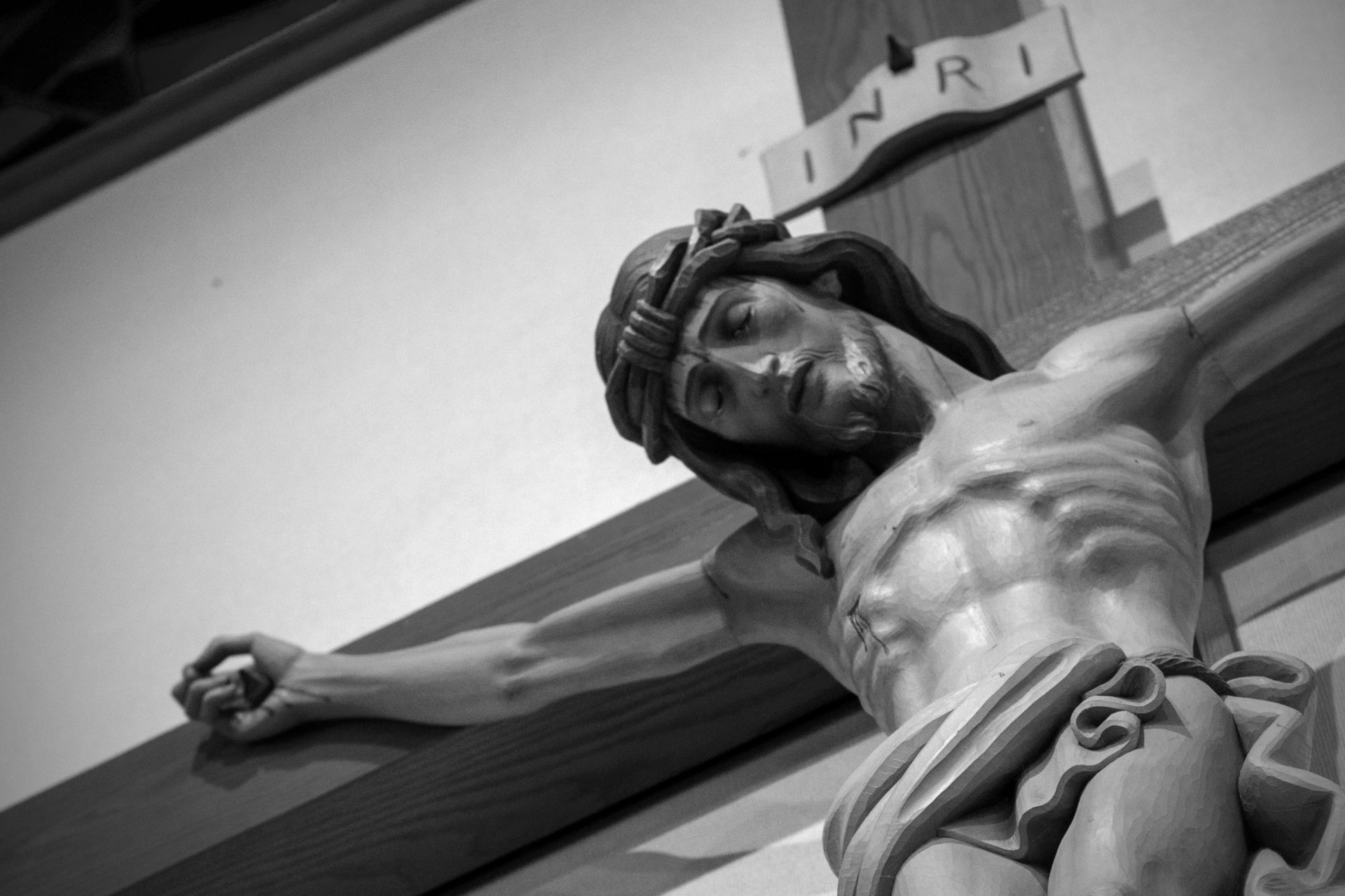
“He humbled himself, becoming obedient to the point of death, even death on a cross.”
Down and down he goes.
From heaven to earth.
From God to man.
From master to servant.
From life to death.
And not simply death—but death on a cross.
We can easily forget how shocking those words would have sounded to the first Christians.
We decorate our churches with crosses. We hang them in our homes. We wear them around our necks.
But for the people hearing these words for the first time, the cross was an instrument of torture and humiliation.
And Paul is saying: that is how far God was willing to go for you.
All the way down.
Into suffering.
Into rejection.
Into humiliation.
Into death itself.
And then the whole movement of the passage changes.
“Because of this, God greatly exalted him and bestowed on him the name which is above every name.”
And then Paul reaches the climax:
“That at the name of Jesus every knee should bend, of those in heaven and on earth and under the earth, and every tongue confess that Jesus Christ is Lord.”
Jesus Christ is Lord.
That is one of the simplest declarations of faith.
But if we really believe it, it may also be one of the most demanding.
Because if Jesus Christ is Lord} then Christianity cannot simply be one part of my life.
The list cannot be my job, my family, my hobbies, my plans, my finances, my ambitions—and then somewhere over here, my faith.
If Jesus Christ really is the Son of God,..
If he really died on that cross…
If he truly rose from the dead…
If he truly established his Church to continue his saving work in the world…
then our faith cannot be something of moderate importance.
It has to become the most important reality in our lives.
Now, that does not mean everyone is called to become a priest.
It does not mean everyone is called to religious life.
Most Christians are not.
But every Christian is called to give his or her life completely to Christ.
For one person, that will mean serving Christ through marriage and raising children in the faith.
For another, it will mean serving him through work, through charity, through caring for aging parents, through teaching, through medicine, through farming, through business, through countless different works of love.
The point is not that we all have to live the same life.
The point is that whatever life we are given has to belong to him.
And so perhaps the question for each of us this weekend is very simple:
How important is Christianity actually to me?
Not how important do I say it is.
Not how important do I think it ought to be.
But if someone looked at the way I spend my time, the way I use my money, the decisions I make, the things I worry about, the things I sacrifice for—what would they conclude: my faith is the most important thing in my life?
Because C. S. Lewis was right,
Christianity cannot be moderately important.
If Jesus Christ is not who he claimed to be, then ultimately none of this really matters,
But if he is who we believe he is—if he is the Son of God, if he died and rose again, if he is truly Lord—then nothing could possibly matter more.
And so St. Paul tells us:
“At the name of Jesus every knee should bend… and every tongue confess that Jesus Christ is Lord.”